Updated January 30, 2026
On December 7, 2025, I took the N1 Japanese Level Proficiency Test in the United States. It is my goal to post my first blog article before the end of the year, and I would like to write about my study journey and various thoughts about the exam. I hope my experience can help others in the future who have the same objective of passing the N1!
The test results are not released until late January of 2026, and I am writing this article early with the bold assumption that I passed the exam. :) Once they are released I will update this post with my results.
the test
According to the American Association of Teachers of Japanese (AATJ), "The Japanese-Language Proficiency Test (JLPT) was developed in Japan, and has been offered since 1984 in countries all around the world as a means of evaluating the proficiency of non-native learners of Japanese." The test has five levels, ranging from the beginner N5, to the most advanced N1. The N1 in particular measures fluency across kanji, vocabulary, grammar, reading comprehension, and listening.
The JLPT tests aim to measure comprehensive understanding of Japanese communication, yet they glaringly leave out writing and speaking. This is pretty odd to me because both of these skills are necessary to become fully fluent in any language. If your sole purpose is passing the N5-1, you are really not going to be practicing these. I see value in practicing writing and especially speaking for their own sake, but the JLPT tests still function as a solid international benchmark of Japanese fluency in the other above-mentioned skills.
The N1 test itself is split up into 110 minutes for vocab, grammar, and reading, followed by a 20 minute break, then a 60 minute section for listening. All of the questions are multiple choice. Vocab/grammar, reading, and listening are scored on a range of 0-60 points, and you must score above 19 points for all three sections, and score at least 100/180 overall to pass the exam. From my understanding, the weighting of individual questions is based on how difficult they are, so answering difficult questions correctly contributes more to a higher point total.
In my opinion, the reading section is by far the most challenging. The N1 gives you short, medium, and long passages on various topics, and you have to be able to not only comprehend these but read between the lines. On the short vocab/grammar questions you can make decent guesses, but the reading section is where your answers are weighted heavily. It takes time to read the passages and understand them, eating away at 110 minutes faster than you may realize. Reading comprehension is the culmination of also understanding advanced kanji, vocabulary, and grammar, so in a sense it is the section that proves if you have what it takes to pass the N1. The listening section feels tame compared to the reading, as long as you have heard lots of native Japanese before.
my background
I have been connected to Japanese for a majority of my life despite not having the language spoken in my immediate family. My grandmother is Japanese, and my parents placed me in Saturday school to study the language and culture since I was 7. This was light exposure over many years, and by the end of high school I had become familiar with both of the Genki I and II textbooks, landing me around the N4-N3 level.
Up until that point Japanese was hardly a part of my life. As I started college, I started to devote more time to learning the language in depth. I decided to minor in Japanese, and I took a placement test that put me in to a "Third-Year Advanced Japanese" class. With lots of planning, I made the huge commitment to study abroad in Tokyo for a year. The experience was amazing in many ways, but most relevant to this article is that it greatly improved my everyday comprehension. I took intermediate and advanced Japanese classes, communicated with my sharehouse roommates + local neighbors, and absorbed Japanese from roadsigns, train announcements, concerts, and more.
I had been aware of the JLPT for a long time from Japanese teachers and classmates, and by June of this year I set my sights on taking the test for myself. I felt confident that the N2 was doable, but the N1 felt completely out of reach. I had never taken a JLPT exam before, and the thought of jumping to the most difficult level was daunting. In spite of my worries I made the mental commitment to register for the closest exam in December, and later in the summer I officially paid the $100 to sign up.
my preparation
I think there are plenty of ways to study effectively for the N1! In my case I focused on a few things that seemed to work:
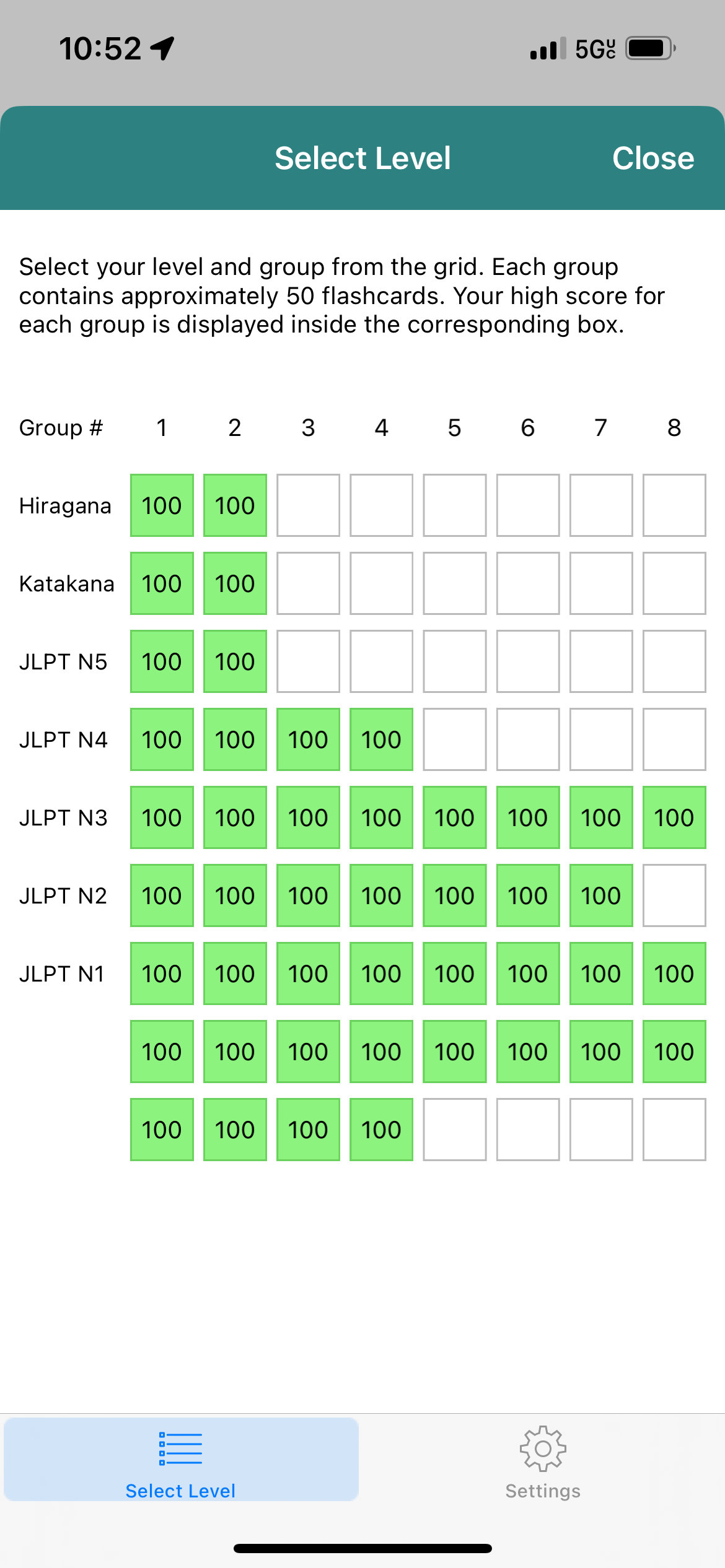
- This is a strange one, but my first priority was the Kanji Quizzer app on the iOS App Store. Categorized from N5-N1, it splits up the most common ~2200 kanji characters into groups of 50 flash cards. I put the cards on kanji -> kana to train my recognition ability. I don't remember where I was at exactly earlier in the year but I know I couldn't identify hundreds of N2 and N1 kanji to save my life. I made it a habit to practice my weakest groups of kanji every day, and I slowly grinded to 100% the app by September. This app made me familiar with way more kanji and vocabulary.
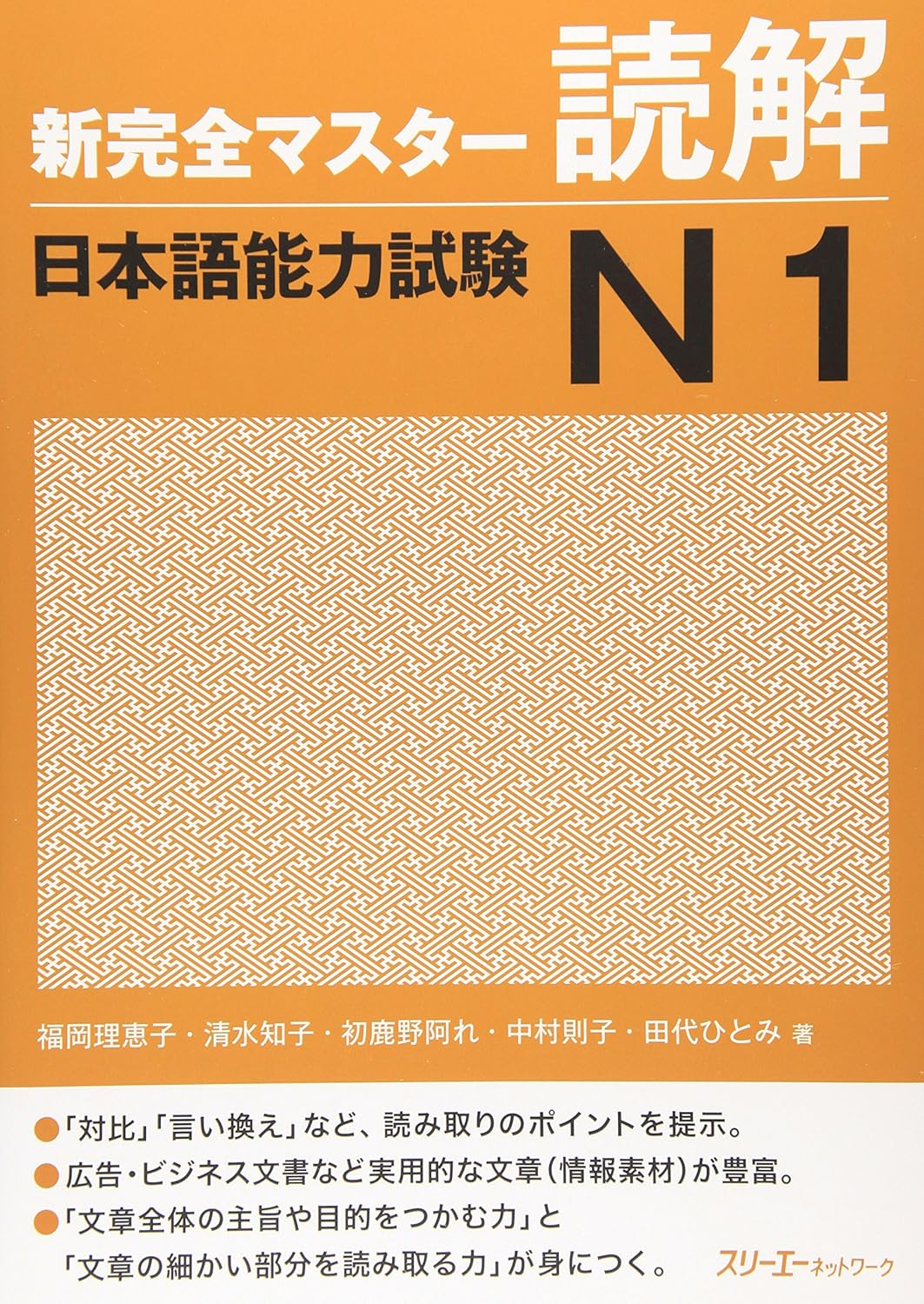
- For N1 reading comprehension, the 新完全マスター読解N1 book was an incredible study material. The questions mimic the N1 perfectly in length and difficulty, and the answers have clear explanations. I also did not find it a drag to study with: the questions include sample e-mails, flyers, social critiques, and novel snippets. The Shin-Kanzen series also has books for grammar, vocab, and kanji, which are probably also high quality but I did not study with these.
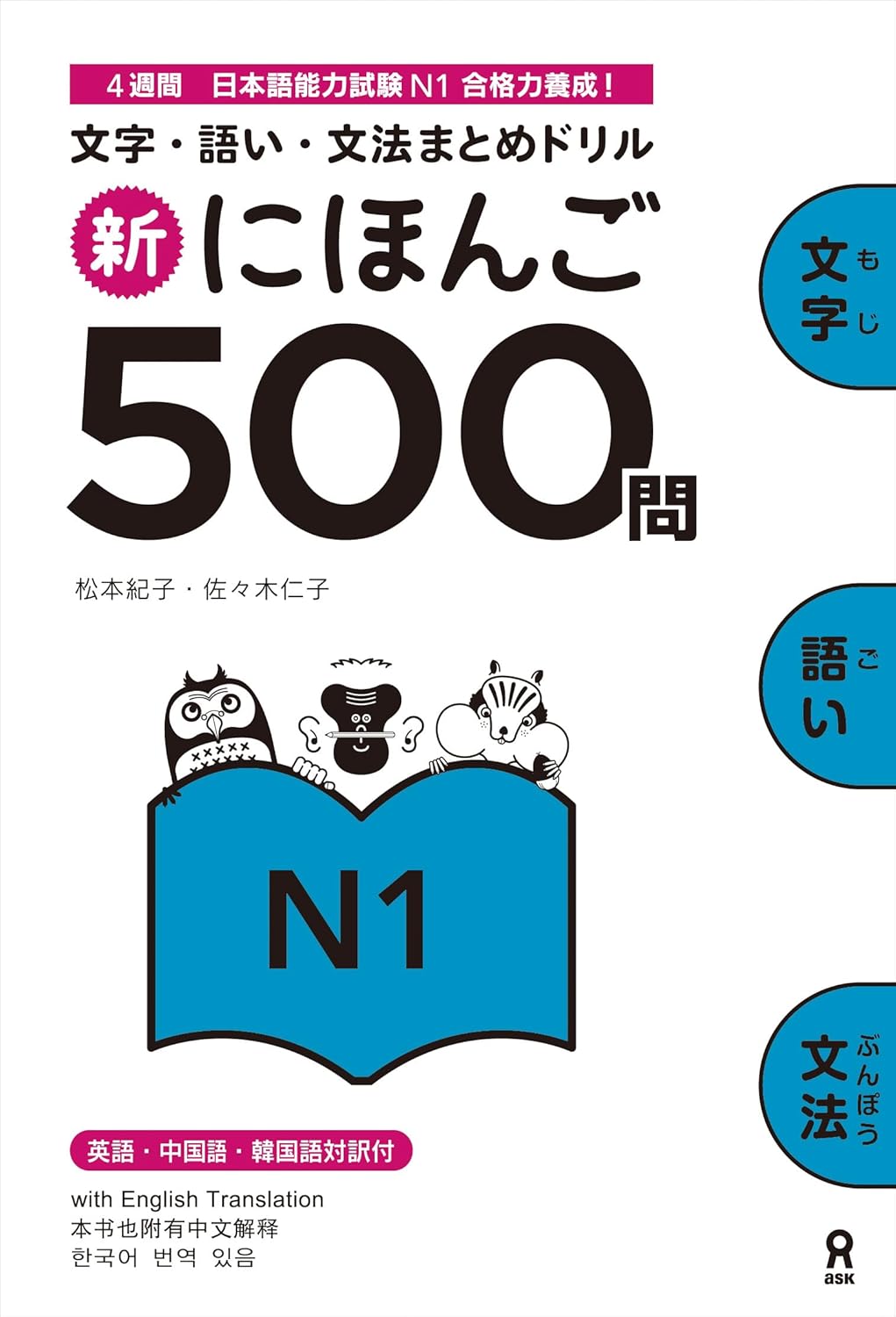
- For vocabulary and grammar I used 新にほんご500問 N1 for practice problems and would highly recommend it. I also got the N2 version so I could familiarize myself with that grammar, but as the test approached I only worked through the N1 problems. I kept this book near my bed and did 15 questions at a time, then reviewed my wrong answers regularly. I ordered both of these books from Amazon while I was still living in Tokyo, but it may be more difficult to get these outside of Japan.
- An additional website I used for vocab and grammar was Challenge JLPT, where I tested myself on the N1 questions incessantly for additional exposure to N1 level terms.
- The only way to get better at reading is to read more. Reading had the benefit of introducing me to more kanji, vocabulary, and grammar outside of the N1 book materials. The bulk of my reading was done on Yahoo Japan news and Gendai Media, where I just clicked on random articles that appealed to me, then I also did a bit of novel reading with Ttsu reader. I tried to mix my reading up frequently to avoid boredom. For reading online it really helped to have Anki set-up for spaced repetition memorization. I used the Yomitan Chrome extension and a monolingual dictionary for automatic definition look-ups, then used the Lapis Anki integration to turn these into flash cards immediately. All of this took some knowledge and work to set up, but was definitely worth the effort! Guides from The Moe Way and Donkuri explain how to configure a similar setup if you are interested.
- For listening practice, I attempted to do practice N1 listening questions on Youtube but that bored me so quickly. Instead I dove into Japanese Youtube and listened to things I actually enjoyed, which was various manzai comedy and Toukai on Air. That probably did not translate much to helping on the N1 but I still counted it as study.
- Last but not least, I did both official practice tests while recreating the exact same conditions as the physical exam. I bought the physical books because it is easy to take the test from them. I realized that the reading section is extremely time-constrained and formulated a personal test-taking strategy for the real deal.
Consistency matters a great deal when preparing for the N1. I had to make the practice enjoyable to keep it up, so I only used the two books and switched up my study materials frequently. Even still I definitely skipped study days here and there leading up to the exam. I have no idea how many hours went into focused N1 study over 4-5 months. The N1 is no joke and requires dedication to pass.
test day
The months went by and soon enough the N1 test day arrived! I slept well the night before, ate some food, brought a watch and a full clear water bottle, and arrived early to the venue. There were so many people gathered outside the building, and I felt powerful climbing to the top floor where only the N1 takers were gathered.
I had a simple strategy for the first portion of the test:
- Did questions in order and rushed through the easy ones
- Skimmed the question and answer choices first
- If possible, I scanned for the bare information I needed
- Underlined everything important in the longer reading sections
- Starred questions where I wasn't sure, skipped them, and returned at the end to make my best guess
All of these test tips apply to any type of multiple choice test so nothing really special here. A bit of a secret tip that I discovered from the practice tests is that the JLPT does not like to put three correct answer choices in a row, and even two in a row is not that common. For example, on the main test I was wary of marking A A A, and would double check if I missed something in one of those questions.
I sped through the first half of the exam according to my strategy, and did not run into many roadblocks doing so. I managed to answer all 70 or so questions with 5 minutes to spare! Once I made it through the first half of the N1, I breathed a sigh of relief because the difficult part was over. I spent the break chatting to one of the other testtakers and had a friendly conversation. I did not realize you could bring a snack to eat during the break, and I jealously eyed the people that brought one. After two hours of intense focus the brain really wants food.
Anyways, I returned to the test room and sat down for the listening section. This part the only strategy I had was to go by vibes. From the practice tests, I found that whatever answer feels the most correct is probably going to be the correct one. I definitely missed some questions here but overall don't think it went too poorly. The final bell of the N1 recording released me into a state of satisfaction and accomplishment. After months of preparation, I felt like I put in a great showing during the final battle.
results
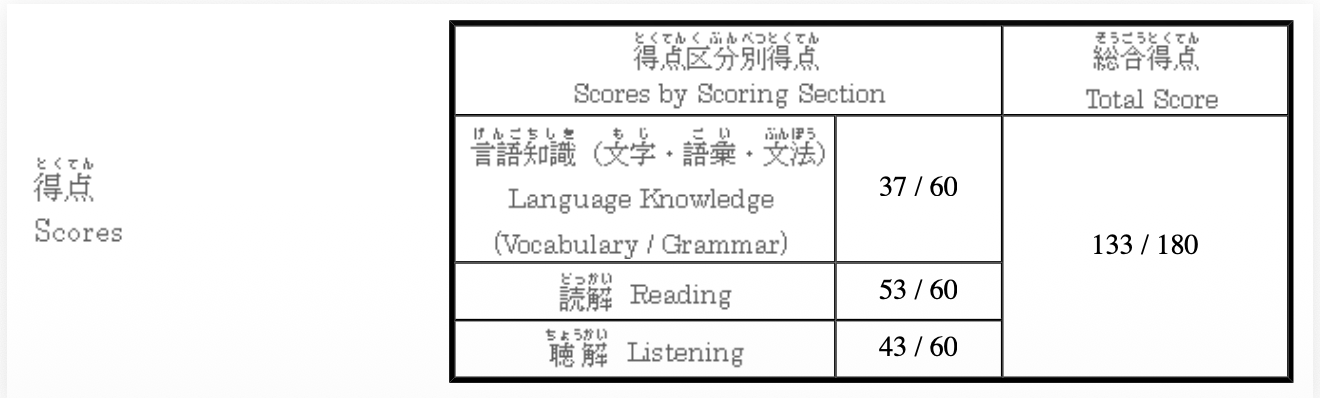
(update) I passed!! I did not do so well on the vocab/grammar and listening, but I am very happy with my performance on the reading section. I feel relieved that I accomplished this result.
This basically sums up my experience studying for and taking the JLPT N1. I hope this article was fun and informative to read whether you study Japanese or not. I plan to maintain my current Japanese level through flash cards and anime/Youtube, improve even further through enjoyable immersion, and probably move to learning Spanish in the future. This is the first ever blog post I've written and I hope to improve at it with more practice. Have a wonderful day!